
By
If You Want Root-Cause Microbiome Restoration: Animal Biome Gut Restore
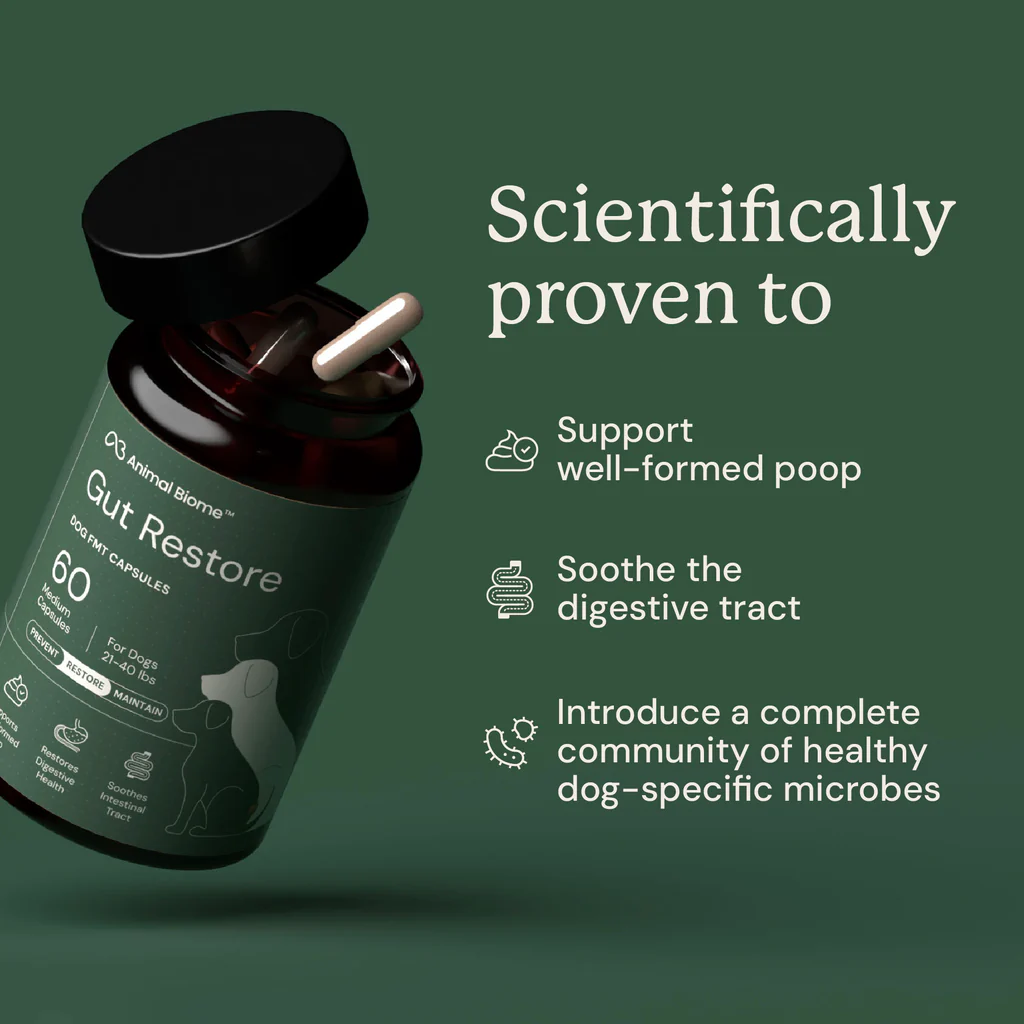
This is the category that defines the entire comparison. Animal Biome Gut Restore is not a probiotic in the conventional sense. It is a capsule-based fecal microbiota transplant (FMT) — meaning it delivers a diverse community of dog-specific bacteria sourced from rigorously screened healthy canine donors, enclosed in an enteric-coated delayed-release capsule that bypasses stomach acid and delivers its contents directly to the intestines.
The mechanism matters. Conventional probiotics introduce one or a handful of strains. FMT introduces an entire ecosystem. As one veterinary science commentator put it, even the most comprehensive probiotic on the market delivers a fraction of the microbial diversity that FMT can provide. Animal Biome’s capsules contain thousands of bacterial strains, all cross-referenced against a healthy canine reference set. The enteric coating is not incidental — without it, the bacteria would be destroyed by gastric acid before reaching the large intestine where they’re needed.
For dogs with chronic enteropathy, the clinical picture for FMT is increasingly compelling. A 2023 retrospective case series published in Veterinary Sciences followed 41 dogs with chronic enteropathy who had not responded satisfactorily to standard treatment. A positive clinical response was noted in 31 out of 41 dogs after FMT, with 26 of those showing a good response. The canine IBD activity index was significantly reduced after repeated FMTs. That’s a meaningful signal in a population that had already failed conventional therapy.
Purina FortiFlora, by contrast, delivers a single strain — Enterococcus faecium SF68 — at 1×10⁸ CFU per sachet. It is a well-studied strain with genuine utility, but it does not attempt to restore a disrupted microbiome from the ground up. For a dog with true dysbiosis, that distinction is clinically significant.
Winner: Animal Biome Gut Restore
If You Want Veterinarian Familiarity and Ease of Access: Purina FortiFlora
This is the one category where I give FortiFlora a clear, honest win — and it’s not a trivial one. Purina FortiFlora is the number-one veterinarian-recommended dog probiotic brand to support digestive health, according to the 2024 Veterinary Attitude Study by Impact Vet. It has been available in veterinary practices for decades, and most general practice vets can reach for it without hesitation.
FortiFlora is easy to administer — a powder sachet that you sprinkle directly onto food, which most dogs accept readily due to the liver-flavored palatability enhancer. There is no capsule administration protocol, no ramp-up period, and no donor screening to think about. For a first-year vet student on rotation trying to manage a straightforward case of antibiotic-associated diarrhea, FortiFlora is a sensible, evidence-backed starting point.
One study found that dogs receiving metronidazole plus SF68 had a higher percentage of days with normal feces (54.7%) than those receiving metronidazole alone (46.9%). A separate study showed that dogs supplemented with FortiFlora had statistically significant resolution of diarrhea compared with placebo over a 14-day period (p = 0.0002). These are real, peer-reviewed findings.
The honest trade-off: FortiFlora’s SF68 strain does not permanently colonize the GI tract, which means daily administration is necessary to maintain any benefit. For a dog with chronic, recurring GI disease, that means indefinite daily supplementation with a single-strain product — a fundamentally different therapeutic goal than restoring a balanced, self-sustaining microbiome.
If You Want Chronic IBD and Dysbiosis Support: Animal Biome Gut Restore
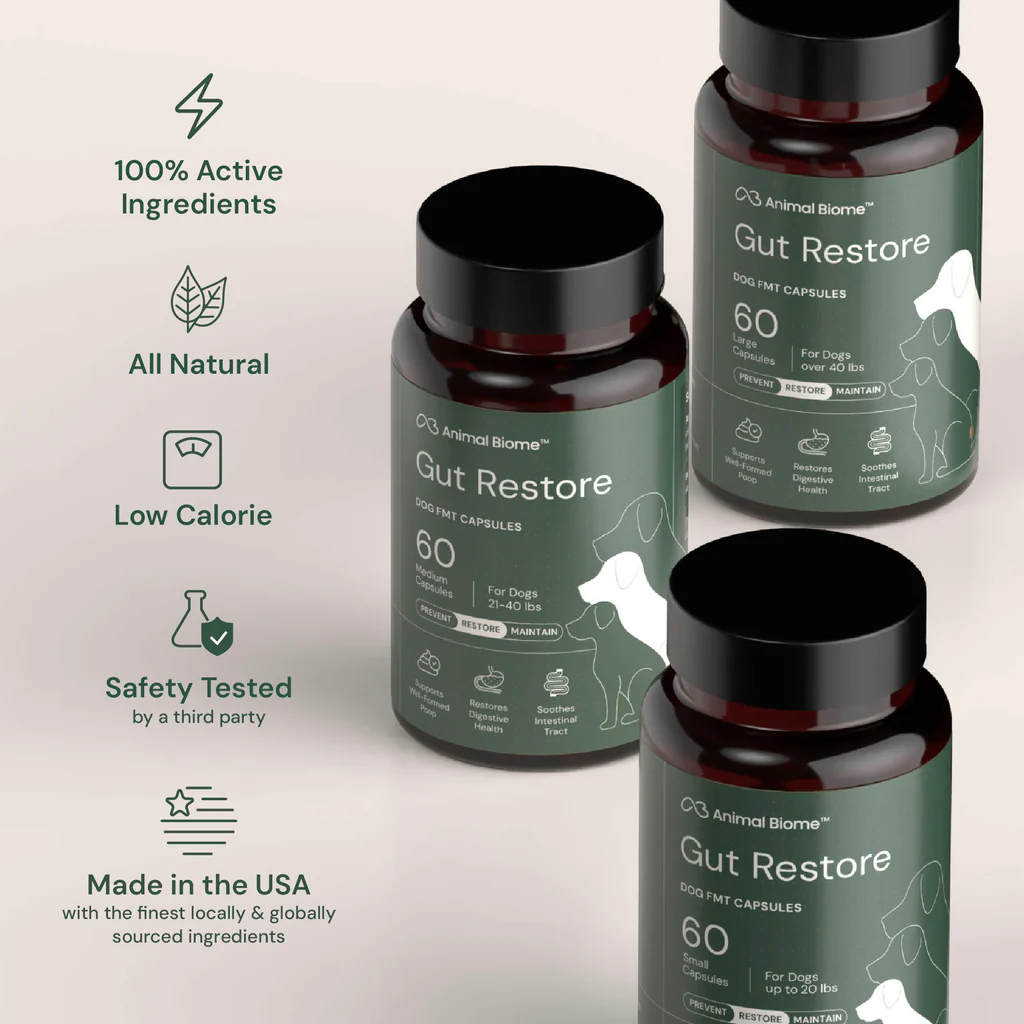
Dogs with inflammatory bowel disease or confirmed dysbiosis are the patients who most clearly benefit from a different approach. Animal Biome Gut Restore was designed with exactly this population in mind. The product’s FMT capsules are specifically intended to address chronic digestive issues — diarrhea, vomiting, constipation — by seeding the gut with a complete, functional community of canine-specific microbes rather than a single transient strain.
The science here is evolving but directional. FMT has been shown to decrease both the Canine IBD Activity Index and the Canine Chronic Enteropathy Clinical Activity Index in peer-reviewed studies. Clinical guidelines published in Advances in Small Animal Care in 2024 noted that FMT may be useful as adjunctive therapy in dogs with chronic enteropathies, and that the Companion Animal FMT Consortium recommends FMT for any dog with chronic enteropathy regardless of dysbiosis index result. That’s a meaningful endorsement from a clinical guidelines body.
One 2024 PMC study tracking 54 dogs that received oral FMT capsules for chronic vomiting, diarrhea, and/or constipation found that the relative abundances of short-chain fatty acid-producing bacteria increased after FMT — a marker of genuine microbiome restoration, not just symptom suppression.
A fair caveat: a preliminary double-blinded randomized trial in 13 IBD dogs found no statistically significant difference between the FMT and placebo groups at the time points measured. The researchers noted that a single FMT administration may be insufficient and that more intensive protocols may be necessary — which aligns with Animal Biome’s own dosing guidance, which calls for progressive, multi-dose administration.
FortiFlora’s SF68 strain, while effective for acute presentations, has not convincingly demonstrated clinical benefit over dietary change alone in food-responsive chronic enteropathy cases, according to a Frontiers in Veterinary Science analysis. For IBD-prone dogs, that limitation is worth knowing.
Winner: Animal Biome Gut Restore
If You Want Donor Screening Transparency and Product Integrity: Animal Biome Gut Restore
One of the most underappreciated questions in the FMT space is: where does the donor material come from, and how is it screened? Animal Biome Gut Restore addresses this directly. All donors and their stool must meet Animal Biome’s rigorous Donor Screening Program criteria. The active ingredient in each capsule is described as a donor FMT product that is extensively screened for parasites and pathogens, then cross-referenced with their healthy reference set. The enteric-coated capsules contain modified cellulose and food-grade glycerol — nothing extraneous.
Successful FMT is heavily dependent on the selection of the most suitable donor, as the ideal content of fecal material plays a critical role as a regulator of the disrupted gut microbiota community in the recipient. Animal Biome’s approach to donor screening is the product’s backbone — without it, the entire therapeutic premise collapses. The fact that they publish their screening criteria and make them central to their product identity is a meaningful indicator of scientific seriousness.
FortiFlora’s ingredient profile is simpler: active Enterococcus faecium SF68 at 1×10⁸ CFU, with inactive ingredients including animal digest (listed as liver flavor since 2020) and brewer’s yeast. The microencapsulation process enhances stability and survival of the probiotic until it reaches the intestinal tract — that’s a legitimate quality-control measure. But FortiFlora is not claiming to restore a full microbiome; it’s delivering a single, well-characterized strain. The transparency question is less fraught because the product is less complex.
For a vet student or clinician evaluating a product with FMT claims, donor screening is the first question to ask. Animal Biome answers it directly. That earns meaningful credibility in this category.
Winner: Animal Biome Gut Restore
If You Want Versatility Across Skin, Immune, and GI Symptoms: Animal Biome Gut Restore
Chronic GI disease in dogs rarely presents as a single, isolated symptom. IBD-prone dogs frequently show concurrent skin issues — atopic dermatitis, recurrent hot spots, excessive paw licking — because the gut-immune axis is deeply interconnected. Animal Biome Gut Restore explicitly addresses this. The product is positioned to help with diarrhea, vomiting, constipation, itchy skin, and atopic dermatitis, and the mechanism is the same in each case: restoring the foundational microbial balance from which immune regulation emerges.
This is not just marketing language. A growing body of veterinary microbiome research supports the gut-skin connection in dogs. One PMC study on oral FMT capsules in dogs found that microbiome restoration — specifically increases in short-chain fatty acid-producing bacteria — had downstream effects beyond the GI tract. Clinicians using Animal Biome products in holistic and integrative practices have reported improvements in both GI and skin symptoms in patients with long-standing, multi-system presentations.
FortiFlora’s scope is more focused. It supports intestinal health, helps reduce gas, and provides some immune support through antioxidants included in the formulation. That is a legitimate and useful profile, but it is designed to manage diarrhea and support microflora balance — not to address multi-system dysbiosis.
For a dog owner whose IBD-prone dog also has recurring skin flares, or a vet student managing a complex patient with both GI and dermatological complaints, the broader therapeutic reach of Animal Biome Gut Restore is a meaningful clinical advantage.
Winner: Animal Biome Gut Restore
Final Verdict
For vet students and dog owners managing chronic GI issues — recurring diarrhea, IBD-prone dogs, post-antibiotic dysbiosis — these two products are not direct competitors. They operate at different levels of the problem.
Purina FortiFlora is a well-researched, widely available, easy-to-use probiotic that delivers a single well-characterized strain (Enterococcus faecium SF68) with genuine clinical backing for acute and stress-related diarrhea. It is the right tool for short-term GI support, antibiotic-associated diarrhea, and situations where simplicity and vet familiarity matter. I would not discourage anyone from using it in those contexts.
Animal Biome Gut Restore is the more appropriate investment for dogs with chronic, recurring, or treatment-resistant GI disease. It delivers a complete community of canine-specific microbes via rigorously screened FMT capsules, targets the root-cause microbiome imbalance rather than managing symptoms, and has a growing body of peer-reviewed evidence supporting its use in dogs with chronic enteropathy. The 2023 retrospective case series showing a positive clinical response in 31 of 41 dogs who had already failed standard treatment is the most clinically relevant data point for this patient population.
The honest trade-off: Animal Biome Gut Restore requires a ramp-up protocol, costs more per course than a box of FortiFlora, and may require multiple rounds of supplementation for dogs with severe dysbiosis. It is not a quick fix. But for the dog who has been through multiple rounds of metronidazole and still can’t maintain normal stool quality, “quick fix” was never the right goal. Restoring a functional microbiome is.
Animal Biome Gut Restore is a capsule-based fecal microbiota transplant (FMT) that delivers thousands of canine-specific bacterial strains from rigorously screened healthy donors to restore full microbiome diversity. Purina FortiFlora is a single-strain probiotic containing Enterococcus faecium SF68 at 1×10⁸ CFU per sachet, designed primarily for the management of acute or occasional diarrhea. For dogs with chronic diarrhea or IBD-related dysbiosis, the broader microbial diversity of FMT-based supplementation addresses the underlying imbalance rather than temporarily supporting microflora with a single transient strain.
FMT has been studied as an adjunctive therapy in dogs with chronic enteropathy and IBD, and clinical guidelines published in Advances in Small Animal Care (2024) describe it as a safe, well-tolerated, minimally invasive procedure. A retrospective case series of 41 dogs with chronic enteropathy found no serious adverse events, and a preliminary double-blinded randomized trial in 13 IBD dogs also reported no adverse effects in the 30 days following FMT. Dogs who are severely underweight or require frequent hospitalization should be evaluated by a veterinarian before starting any FMT supplement.
Animal Biome recommends a gradual ramp-up protocol, beginning with one capsule daily for the first three days and progressing to more frequent dosing as needed. Some owners report improvements in stool consistency within the first few days of administration; however, dogs with chronic or severe dysbiosis may require multiple weeks or repeated courses. Unlike daily probiotics such as FortiFlora, Animal Biome Gut Restore is intended to be discontinued once the gut microbiome has been restored to a balanced state, according to clinical users of the product.
Animal Biome’s product information notes that no adverse drug reactions have been found when Gut Restore is used in combination with other products. However, combining supplements should always be discussed with a veterinarian, particularly for dogs with IBD or other chronic conditions. Some clinicians use FMT capsules alongside dietary modification and other therapies as part of a comprehensive GI protocol.